Diagnosing my family tree
Diagnosing my family tree https://help.heredis.com/wp-content/themes/corpus/images/empty/thumbnail.jpg 150 150 Heredis Help Knowledgebase https://help.heredis.com/wp-content/themes/corpus/images/empty/thumbnail.jpgHeredis offers a comprehensive tool for performing a technical and genealogical analysis of your file.
It can be accessed from the Tools menu > Diagnosing my family tree
You can perform this diagnostic using these three functions:
– Check the file
– Consistency Control
– Genealogical Controls
You can use them separately, they are completely independent.
Check the file
This feature is used to verify the integrity of your file.
You can run it right away, even if your file is open.
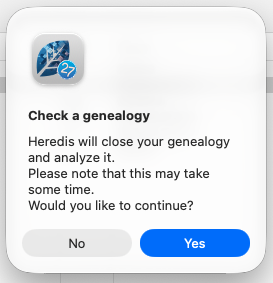
After clicking on the “Check the file” menu, Heredis will prompt you to close your file so it can analyze it.
It will inform you that this may take quite a while, especially for large family trees.
After the analysis, Heredis will inform you of the status of your file and offer to repair it if necessary. This process requires no action on your part.
Heredis will automatically reopen your file once the analysis is complete.
For more details about this feature, see Check a genealogy.
Consistency Control
After entering or importing data, you may easily end up with events whose dates are inconsistent with those of the person’s other events, as well as those of their parents, children, and so on.
This tool allows you to check the consistency of these dates throughout your entire file, based on the application’s preferences.
This check will allow you to correct these inconsistencies as needed, resulting in a cleaner, more consistent file, with more reliable data.
See the detailed article: Consistency Control
Genealogical Controls
This feature will be very helpful in identifying unnecessary, missing, or redundant information in your family tree.
Heredis helps you identify duplicate individuals in your family tree, events with no information at all, and individuals without first names—to name just a few examples.
You can review all of these elements to make your file more comprehensive and avoid being overwhelmed by unnecessary or incomplete information.
See the detailed article: Genealogical Controls